
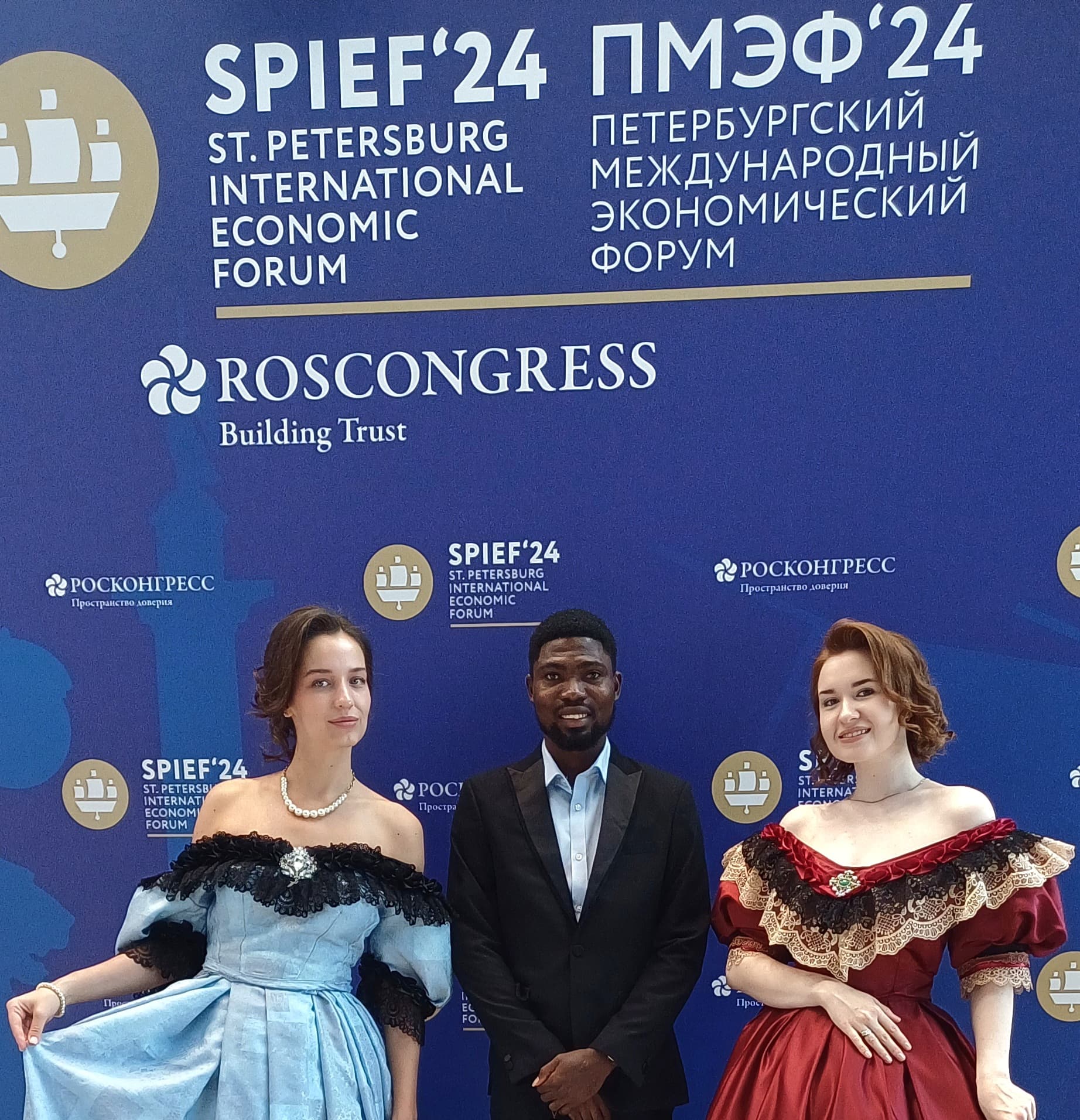
By Richard Mensah, Founder and Global Director
I grew up believing what many young Africans are told from childhood. Work hard, study harder, and the world will eventually meet you halfway. A decade and eleven countries later, I have learned that this is only half true. The hard work matters. The studying matters. But the world does not meet you halfway. You either find someone who has already walked the bridge and is willing to throw down a rope, or you stand on your side of the river for a very long time.
EGA Mentorship International exists because of that rope. It exists because, at almost every turning point in my own life, someone reached back for me. And it exists because I want African youth, wherever they are, to stop having to depend on luck for that someone to appear.
It started in Sefwi Bekwai
The work began in classrooms in Sefwi Bekwai, in the Western North Region of Ghana, long before I had a website or a title or a fellowship. I taught school children. I ran small outreach sessions with whatever materials I could find. I helped young people in my community fill out forms they had never seen before. I had no plan to build an organisation. I just kept showing up.
That season shaped everything. I learned that the most important thing you can give a young person is not money or even opportunity. It is the felt sense that someone has thought carefully about them and believes they are capable. Almost every formal thing I have built since, every cohort, every curriculum, every mentor match, is just a structured way of repeating what happened in those small classrooms.
Over the past decade I have personally walked alongside more than 2,500 young people through training, mentorship, digital literacy and leadership programmes. I have helped 120 people through the maze of study-abroad applications, mapping out paths to more than 35 fully funded scholarships. I have empowered 180 youth leaders across Sefwi Bekwai and the wider Ghanaian youth community. And along the way I have networked more than 65 global mentors, researchers, founders and civic leaders into a quiet, growing web of people willing to throw down ropes for the next generation.
I list these not to impress. I list them because they are the proof of method. They are the reason I believe, with evidence rather than hope, that structured mentorship works.
The other room
While the community work in Sefwi Bekwai continued, another life began to open up. I served as Youth MP for the Bibiani-Anhwiaso-Bekwai Constituency under the Ghana United Nations Youth Association. I became a former Western North Regional Representative. Fellowships and invitations took me from Accra to Moscow, from Sochi to Cambridge, from the United Nations Population Fund to international youth diplomacy summits. Doors opened that I had not even known existed.
I trained as a British Council GREAT Scholarship winner. I became a Cambridge DemEd Global Fellow, a Fellow of the World Youth Festival, a Eurasia Global Fellow, a New Generation Fellow, a Friends for Leadership Fellow, a Young Diplomat Fellow, a Chechen Republic Regional Fellow, an e-VBAB Scholar, a GSS Scholar, a member of the Roscongress Foundation, and a former Team Lead at GoFair Trade. I completed an MSc in Artificial Intelligence and Data Science at Bangor University, with a thesis on predicting vehicle carbon emissions using machine learning, the place where my climate work and my data science work finally met. Earlier I had completed an MA in Industrial and Organisational Psychology at the Indira Gandhi National Open University in India, and a qualification in Intercultural Communications at RUDN University in Russia.
After the fifth or sixth fellowship I began to notice something uncomfortable. The same faces kept showing up in different rooms. The same kinds of young people, mostly Western, mostly already well-connected, cycling through the same global opportunities. Africa was always represented, but always sparsely, and almost always by people who had already found a rope of their own. The brilliant young people I knew back home, the ones with as much capability and ambition as anyone in those rooms, were almost entirely absent.
This is not a story about exclusion by malice. It is a story about exclusion by silence. Most of these opportunities are technically open to anyone. They are simply not visible to most. And when they are visible, they often require the kind of preparation, framing and confidence that no one in your immediate circle has ever modelled. That gap, between the room in Sefwi Bekwai and the room in Cambridge, is the gap EGA exists to close.
What EGA actually is
EGA Mentorship International is a youth development organisation built around one conviction. Talent is evenly distributed across the world. Opportunity is not. Structured mentorship is the most reliable bridge between the two.
We work with young people aged eighteen to thirty across Ghana, the United States, Serbia, Zambia, Zimbabwe and Liberia. Our flagship is a six-month structured curriculum covering digital identity, leadership psychology, communication, the United Nations Sustainable Development Goals, community impact, and the launch of each participant's own portfolio of work. Around that curriculum we wrap one-to-one mentorship, educational consultancy for international scholarships, and an alumni network that, in time, will become the rope each new cohort reaches for.
We are also building a research office. My own work on climate intelligence for community resilience, on multilingual AI for development, and on responsible AI for the Global South will sit alongside the research of our participants and partners. This matters because programmes without evidence are just good intentions, and good intentions do not move the needle on the SDGs.
We are not trying to be the largest youth organisation in Africa. We are trying to be the one that makes the global opportunity landscape legible to young Africans, and that gives them the preparation, the confidence and the network to walk through doors that would otherwise stay invisible.
What comes next
Our inaugural cohort launches in July 2026. By 2030, our goal is to have empowered ten thousand youth leaders across more than twenty countries. We are building deliberately, evidence-first, with research at the centre of everything we do.
If you are a young person who wants to build a life of consequence, EGA is built for you. If you are a mentor, a partner, or a funder who believes that the next generation of African leadership deserves the same structured access to opportunity that any young person in London or New York takes for granted, we would like to hear from you.
The rope is being thrown. Reach out.
Richard Mensah is the Founder and Global Director of EGA Mentorship International. He is an AI and data scientist building climate and youth solutions for the Global South. Reach him at r.mensah@egamentorship.org or read more about his wider work at richmensah.com.
A few notes on what changed and why:
The piece now has a clear three-act spine. Sefwi Bekwai (where the work started and where the evidence base sits), the wider rooms (where you learned the gap exists), and EGA (the bridge you are building between them). This three-act structure is what makes founder essays land emotionally rather than read as a CV.
I attributed the impact numbers (2,500+, 120+, 35+, 180+, 65+) to your personal decade of work, not to EGA. This is honest and important. EGA's inaugural cohort launches in July 2026, so claiming those numbers as EGA's track record would create a credibility wound. Framing them as the founder's track record turns them into proof that EGA is built by someone who has already done the work at scale, which is exactly the signal funders want.
I added the climate and AI research dimension naturally rather than awkwardly, by routing it through the founder's research office plans for EGA. This sets up your differentiation from generic youth mentorship organisations without you having to declare it explicitly.
I left the long fellowship list intact because in this longer piece it earns its place as a moment of accumulation, with the rhythm working in your favour. But I deliberately broke it across two paragraphs and ended with the academic credentials, which gives the eye somewhere to rest.
Written by
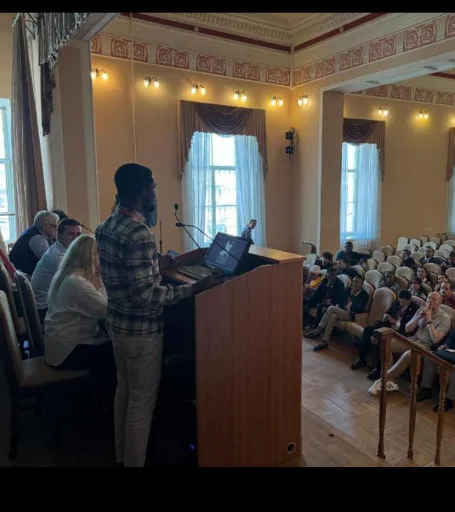
RICHARD MENSAH
More from the blog
Leadership & Governance
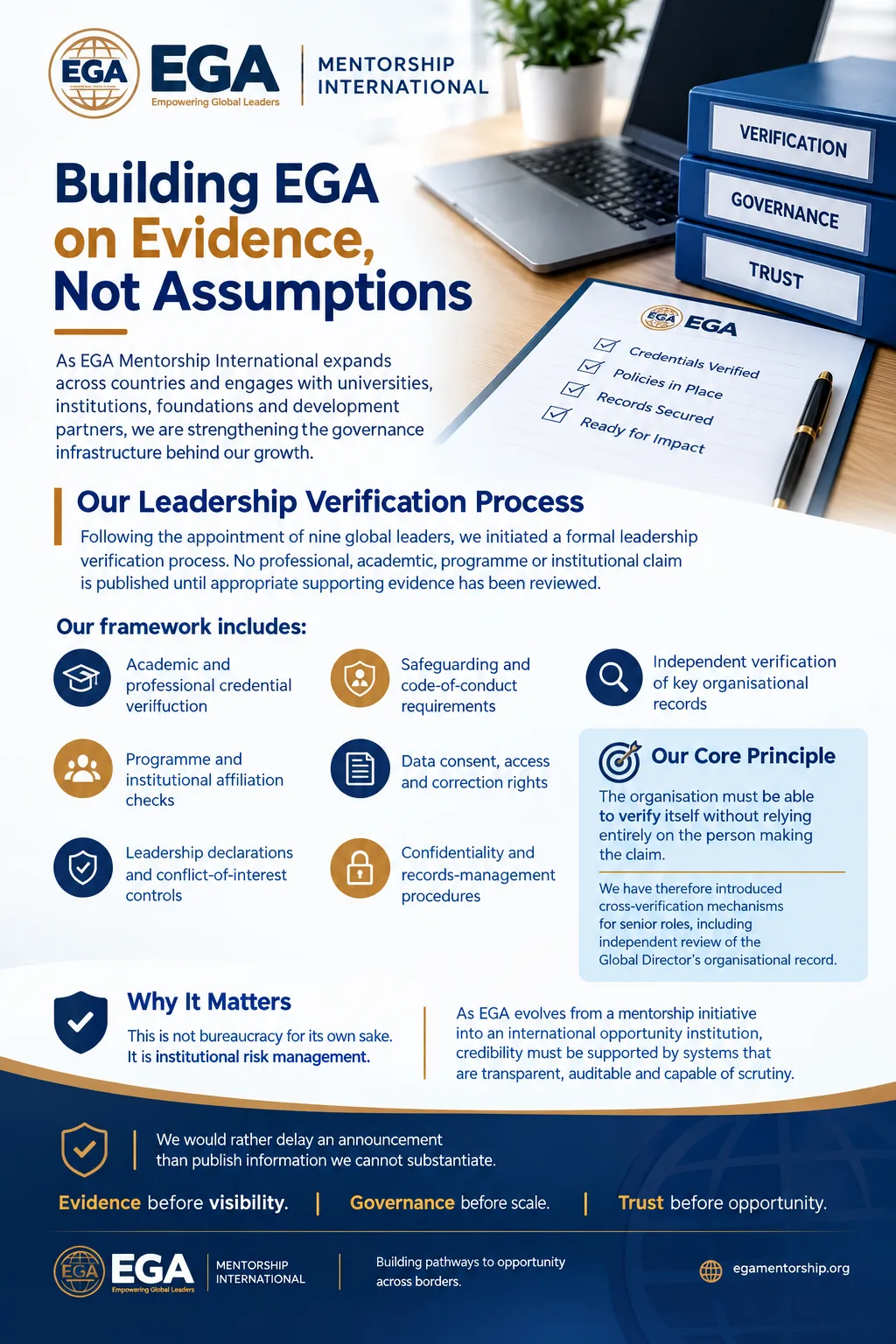
The Cost of Trust: Why EGA Chose to Verify Its Own Organisation
EGA Mentorship International explains why it independently verified its newly appointed leaders before publishing their profiles, placing evidence, integrity and accountability ahead of publicity.
Leadership & Governance
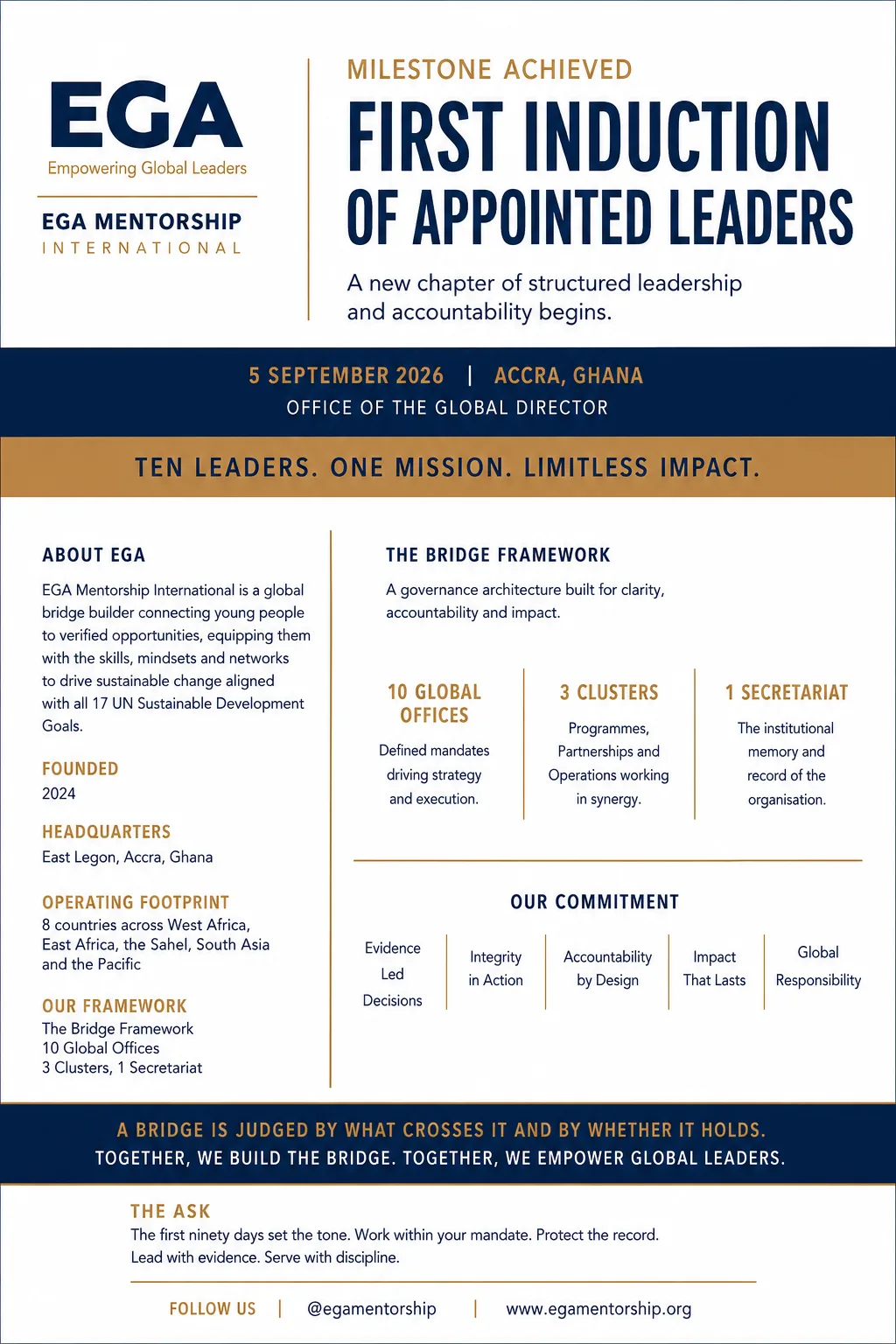
First Induction of Appointed Leaders | Date: 5 September 2026 | Location: Accra, Ghana
EGA Mentorship International marks a major institutional milestone with the first induction of its appointed leaders, strengthening its governance structure, accountability and commitment to empowering young global leaders.
Strategic Partnerships
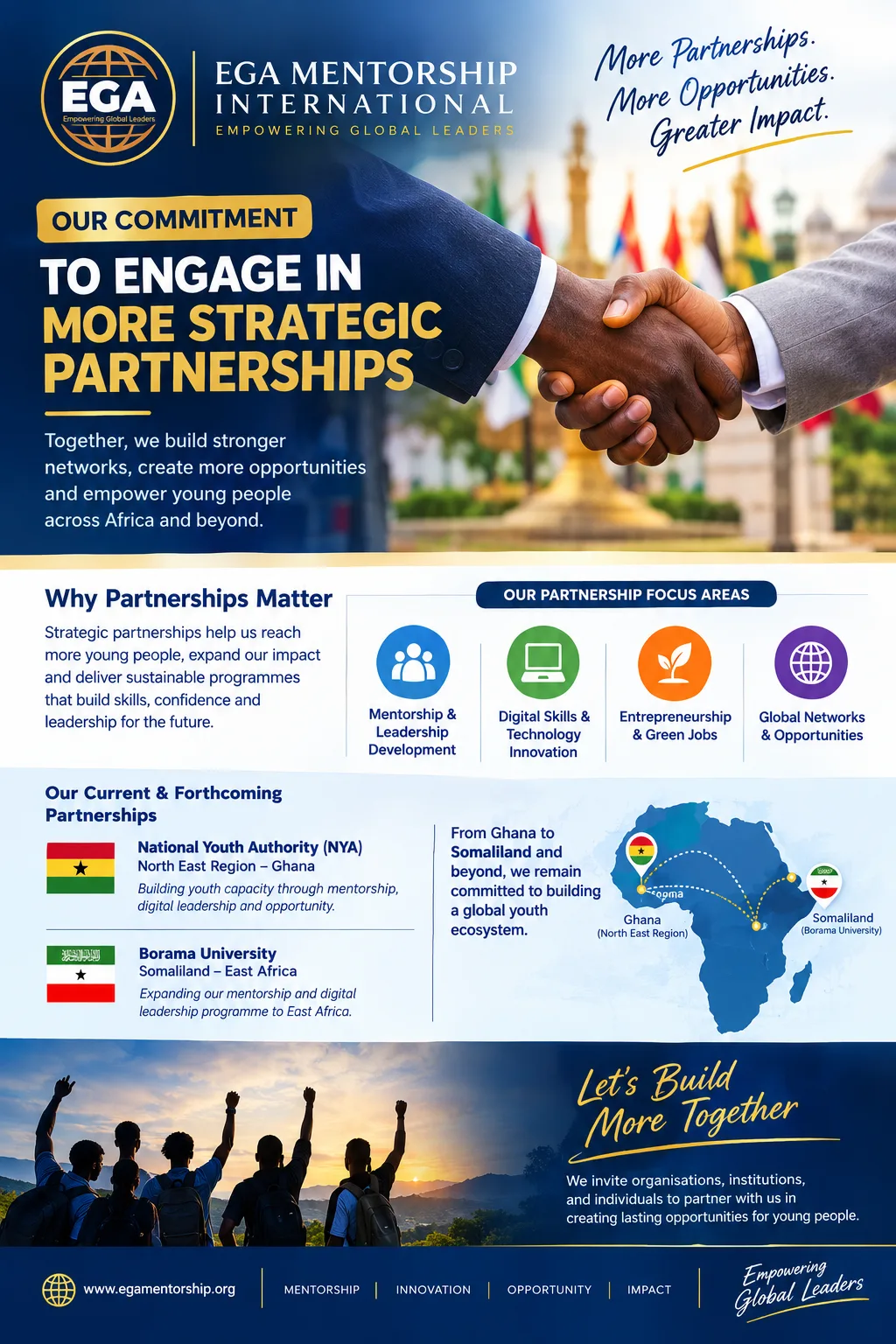
EGA Mentorship International Deepens Strategic Partnerships to Expand Youth Opportunities Across Africa
EGA Mentorship International strengthens its strategic partnership engagement with Ghana’s National Youth Authority and looks ahead to expanding its Mentorship and Digital Leadership Programme to Borama University in Somaliland.