
Leadership & Governance
First Induction of Appointed Leaders | Date: 5 September 2026 | Location: Accra, Ghana
September 5, 2026
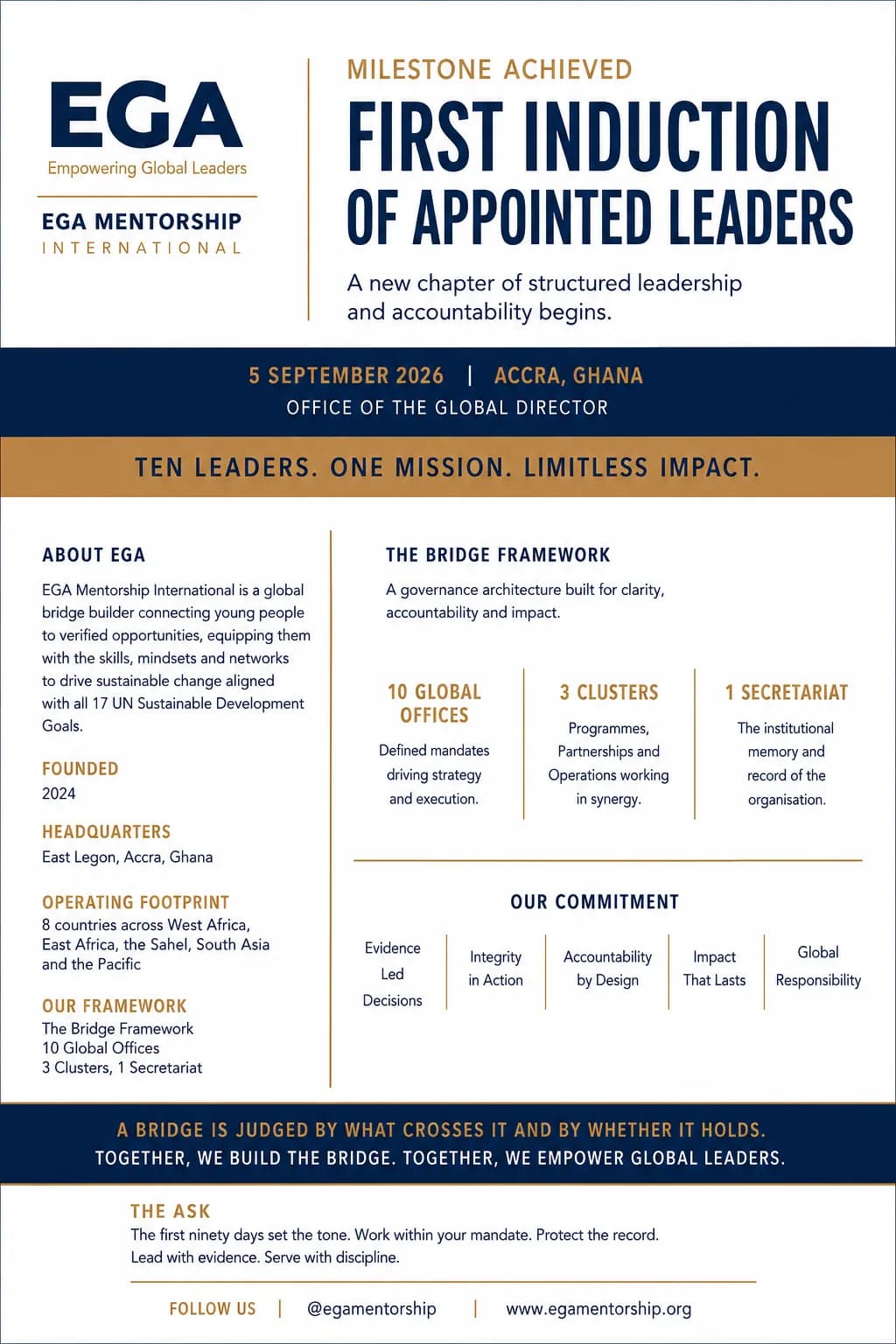
Purpose: This communications package translates the leadership induction presentation and the supplied event video into publication-ready organizational communications. It is designed for the EGA website, internal circulation, partners and social media.
1. Communication Analysis
The event communicates a clear institutional shift: EGA Mentorship International is moving from a model centred on a single office toward a defined governance structure in which ten offices hold specific mandates, the Secretariat maintains institutional records and the Global Director retains approval authority. The central message is that leadership at EGA is a working responsibility, not an honorary title.
The strongest communications themes are accountability, evidence, defined authority, verified experience, responsible public representation, safeguarding, documentation and disciplined delivery. The presentation repeatedly positions evidence as the basis for organisational credibility: claims should be supported, work should be documented, and experience should be verifiable.
The video visually confirms a formal online induction setting, with leadership presentation slides and a multi-participant meeting visible during the session. The supplied deck provides the detailed factual basis for the event narrative; no claims about individual spoken remarks have been added where the supplied materials do not provide a transcript.
2. Publication-Ready Press Release
EGA Mentorship International Inducts Ten Appointed Leaders as Organisation Strengthens Global Governance
Accra, Ghana, 5 September 2026 -EGA Mentorship International has formally inducted its newly appointed leaders, marking a significant step in the organisation’s transition toward a structured, accountable and evidence-led governance model.
The First Induction of Appointed Leaders, convened by the Office of the Global Director in Accra, introduced the responsibilities, decision rights, standards and reporting expectations attached to EGA’s ten appointed offices. The induction emphasised that an appointment at EGA is a working office with a defined mandate, commitment, documented standards and a verifiable record of contribution.
Under the Bridge Framework, the ten offices are organised across three broad clusters: Programme Delivery, Global Positioning, and Evidence and Systems. Together, the structure is intended to clarify who leads, who delivers, who verifies, who represents the organisation and how decisions move through the institution.
The appointed leadership team includes Hannah Appiah for Legal and Human Resources and Head of the EGA Secretariat; Robert Aryeh for Technology, Software and AI Innovation; Isbah Arshad for International Relations and Diplomacy; Derick Amponsem for Programmes and Cohort; Cudjoe Philemon Otuah for Communications, Media and Brand; Jonas Ehorkey for Talent and Quality and the Learn2Earn Korkor Project; Bright Eghan for Research and Policy; Shepelina Oksana as Country Director, Russia and lead for the Accra to Moscow Pathway; Kenneth Adu-Akwakeng for Global SDGs and Support; and Laila Adam for Digital Systems and Innovation.
A major feature of the induction was the organisation’s emphasis on verified experience. EGA’s Verified Experience Record is designed to document actual hours worked, named deliverables, assessed competency and supervisor attestation rather than simply recording time spent in a programme or years of claimed experience.
The induction also established expectations around public representation, confidentiality, safeguarding, data protection, conflict-of-interest declarations and documentation. Leaders were reminded that EGA’s public claims must remain evidence-based and that unsigned or unverified partnerships must not be presented as formal agreements.
The leadership team was further tasked with identifying one named deliverable for each office to be pursued within the first ninety days, with 4 December 2026 identified as the first accountability gate. The approach reflects a broader organisational principle: progress should be measured through evidence of work and outcomes, not titles or tenure.
The induction concluded with a renewed emphasis on EGA’s identity as a bridge builder. The organisation describes its purpose as helping young people cross the gap between potential and verified opportunity by equipping the next generation of leaders with skills, mindsets and networks to contribute to sustainable change across the seventeen Sustainable Development Goals.
The event therefore represents more than an internal appointment ceremony. It establishes a practical leadership framework intended to make EGA’s work more transparent, accountable and capable of being verified by participants, partners and the wider public.
3. Website Article
Building the Bridge: EGA Inducts Its First Appointed Leadership Team
On 5 September 2026, in Accra, Ghana, EGA Mentorship International marked an important moment in its institutional development: the First Induction of Appointed Leaders.
For EGA, leadership is not simply about receiving a title. It is about accepting responsibility for work that can be seen, measured and verified. The induction brought this principle to the centre of the organisation’s next chapter.
From one office to a structure
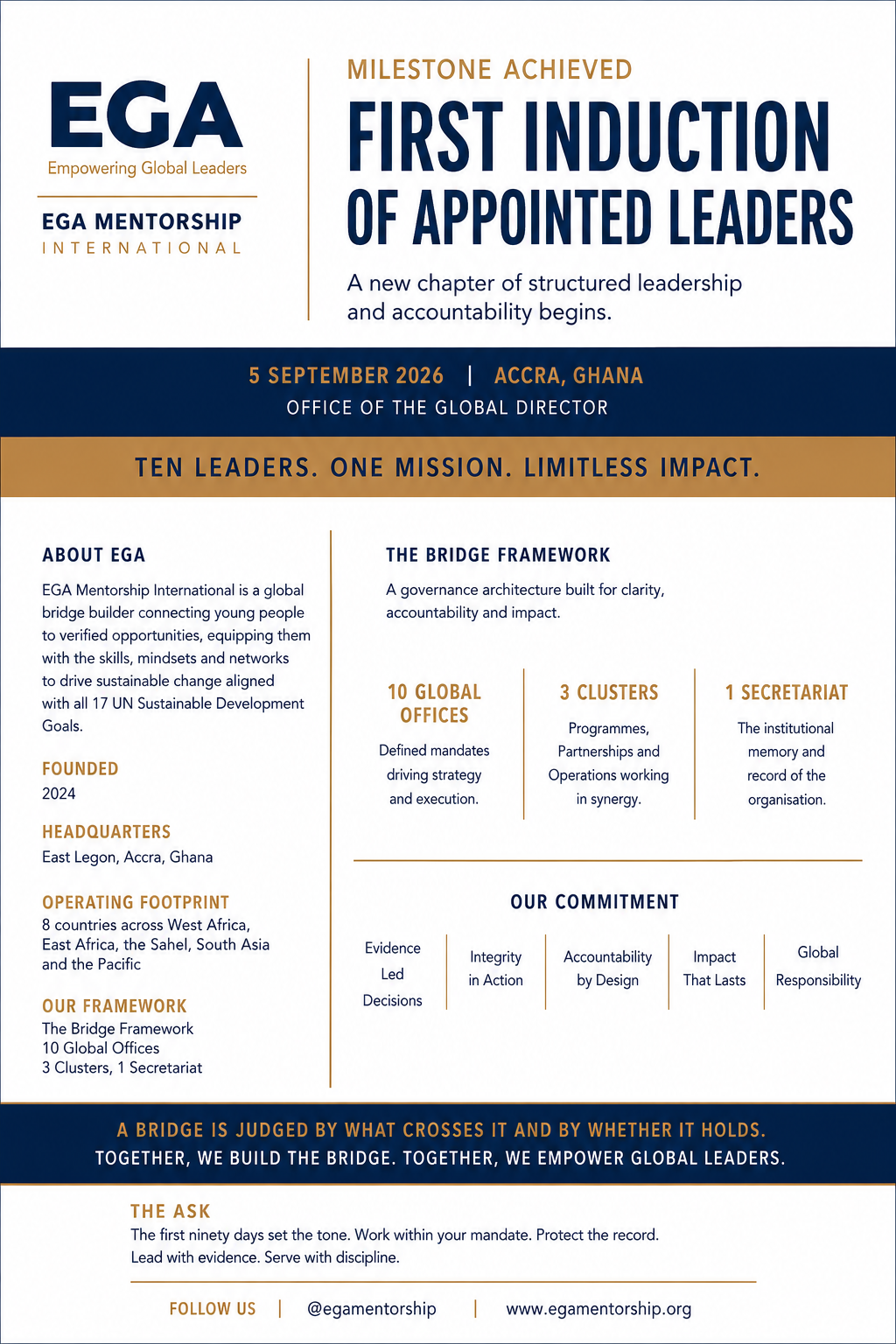
EGA’s leadership model is evolving from a system in which major organisational decisions ultimately passed through a single office to a structure of defined mandates. Ten offices now carry specific areas of responsibility, while the EGA Secretariat maintains the institutional record and supports the movement of work through the governance system.
This change is designed to make responsibility clearer. Leaders are expected to understand what they can decide, what they should route and what must be escalated. In this model, authority is accompanied by boundaries.
A working office, not a title
The induction established four foundations for an EGA appointment: a named mandate, a defined commitment, a documented standard and a verifiable record. Leaders are expected to contribute between six and fifteen hours each week, work within agreed standards and leave an evidence trail of what they have delivered.
This philosophy is particularly important to EGA’s approach to youth development. The organisation’s method focuses on creating opportunities for young people to undertake real responsibilities rather than simply accumulating certificates for attendance.
The Bridge Framework
The new structure is organised around three clusters. Programme Delivery connects participants to real work and maintains delivery standards. Global Positioning carries EGA’s name outward through international relations, communications and SDG alignment. Evidence and Systems supports research, technology, legal and human-resource functions, and digital systems.
At the centre is the Secretariat, which holds the institutional record, manages provenance and routes work between offices. This architecture is intended to help EGA grow without losing clarity about who is responsible for what.
Evidence before exaggeration
One of the strongest messages from the induction was simple: nothing should be claimed that cannot be evidenced. This applies to proposals, reports, presentations, conversations with partners and public communications.
The principle also shapes EGA’s Verified Experience Record. The record is intended to document verified hours, named deliverables, assessed competency and supervisor attestation. It does not claim employment, academic credit, regulated qualifications or a general endorsement beyond the work assessed.
For young people entering a competitive labour market, this distinction matters. EGA’s stated ambition is to help turn participation into credible evidence of what a person has actually done and learned.
Leadership with accountability
The induction also placed strong emphasis on responsible leadership. Conflict-of-interest declarations are required; safeguarding concerns must follow a defined route; participant information must be handled carefully; and public representatives must not make commitments on behalf of EGA without the appropriate authority.
The leadership team’s first accountability point is 4 December 2026. Each office is expected to work toward one named ninety-day deliverable. The message is deliberately practical: an appointment becomes meaningful through delivery.
A bridge judged by what crosses it
EGA describes its name as meaning 'bridge builder'. That image captures the organisation’s broader purpose: connecting young people with verified opportunities, skills, networks and practical experience.
The First Induction of Appointed Leaders is therefore a foundation for the next stage of that work. It is a commitment to clearer governance, disciplined leadership and evidence that can stand beyond the moment in which it was produced.
As EGA moves forward, the standard is clear: build the bridge carefully, document what crosses it, and make sure the bridge holds.
4. Leadership Offices
Legal and Human Resources — Hannah Appiah; Head of the EGA Secretariat
Technology, Software and AI Innovation — Robert Aryeh
International Relations and Diplomacy — Isbah Arshad
Programmes and Cohort — Derick Amponsem
Communications, Media and Brand — Cudjoe Philemon Otuah
Talent and Quality / Learn2Earn Korkor Project — Jonas Ehorkey
Research and Policy — Bright Eghan
Country Directorate, Russia / Accra to Moscow Pathway — Shepelina Oksana
Global SDGs and Support — Kenneth Adu-Akwakeng
Digital Systems and Innovation — Laila Adam
5. Social Media Copy
LinkedIn/Facebook: Today, EGA Mentorship International took an important step in its institutional journey with the First Induction of Appointed Leaders in Accra, Ghana. Ten appointed offices have now been formally brought into a governance structure built around clear mandates, evidence, accountability and responsible leadership. From Programme Delivery to Research, Technology, International Relations, Communications and Digital Systems, the new leadership structure is designed to help EGA grow with greater clarity and discipline. The next milestone is 4 December 2026 — the first ninety-day accountability gate. We are building the bridge, and we are committed to making sure it holds.
#Leadership #YouthDevelopment
6. Editorial / Publication Notes
Recommended website category: Leadership & Governance
Recommended excerpt: EGA Mentorship International has formally inducted ten appointed leaders, introducing a new governance structure built around defined mandates, evidence, accountability and verified experience.
Written by

RICHARD MENSAH
More from the blog
Leadership & Governance
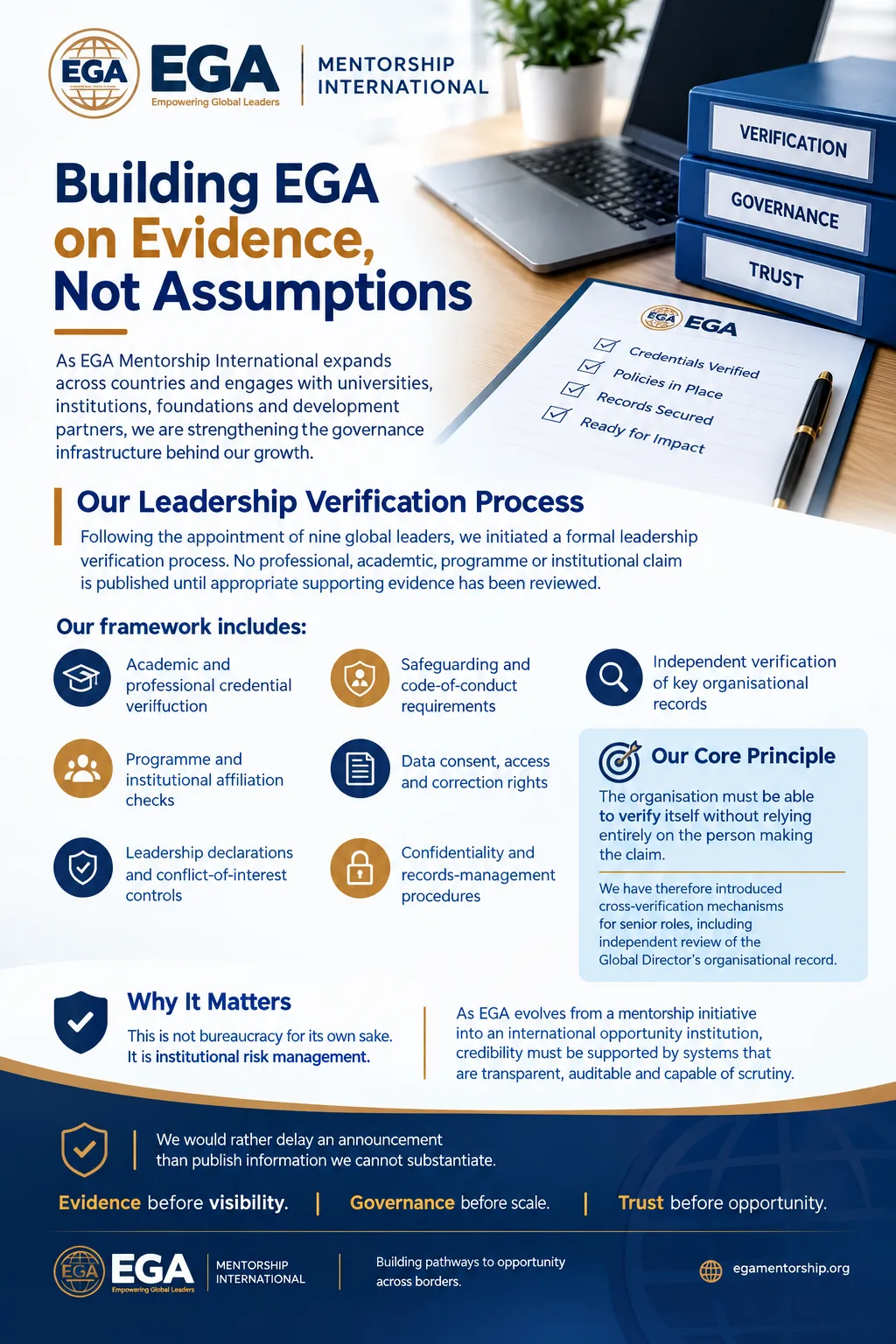
The Cost of Trust: Why EGA Chose to Verify Its Own Organisation
EGA Mentorship International explains why it independently verified its newly appointed leaders before publishing their profiles, placing evidence, integrity and accountability ahead of publicity.

Strategic Partnerships
EGA Mentorship International Deepens Strategic Partnerships to Expand Youth Opportunities Across Africa
EGA Mentorship International strengthens its strategic partnership engagement with Ghana’s National Youth Authority and looks ahead to expanding its Mentorship and Digital Leadership Programme to Borama University in Somaliland.

Healthcare & Community Impact
Compassion Without Borders: How EGA Mentorship International Is Shaping My Mission to Restore Dignity to the Elderly
A young Ghanaian nurse shares how compassion, purpose, and the mentorship of EGA Mentorship International have inspired her commitment to restoring dignity to the elderly while building a vision for healthier communities across Ghana, Africa, and the world.